15 November 2026
How to stay dry in sideways rain
The short answer: to stay dry in sideways rain, you need cover on the sides and the lower half of your body, not just overhead. Tilt your umbrella into the wind, keep your bag inside your coat or under cover, and protect your legs with overtrousers or a full body umbrella whose clear shield hangs almost to the ground.
Why a normal umbrella leaves you wet
An umbrella is a roof. It works when rain falls straight down. Add a breeze and the rain comes in at an angle, under the canopy, onto your trousers, shoes and bag. That is why you can arrive with a dry head and soaked knees.
Seven ways to stay dry in sideways rain
1. Tilt the umbrella into the wind
Point the canopy towards the rain rather than holding it straight up. It sounds obvious, but most of us hold an umbrella upright out of habit. Tilting it covers more of your front and stops the wind getting underneath.
2. Cover your legs
Your legs take most of the wet in angled rain. You have two practical options:
- Overtrousers pull on over your normal trousers. Look for leg zips that let you get them on over shoes. They keep your legs dry, but you need somewhere to take them off and store them when you arrive.
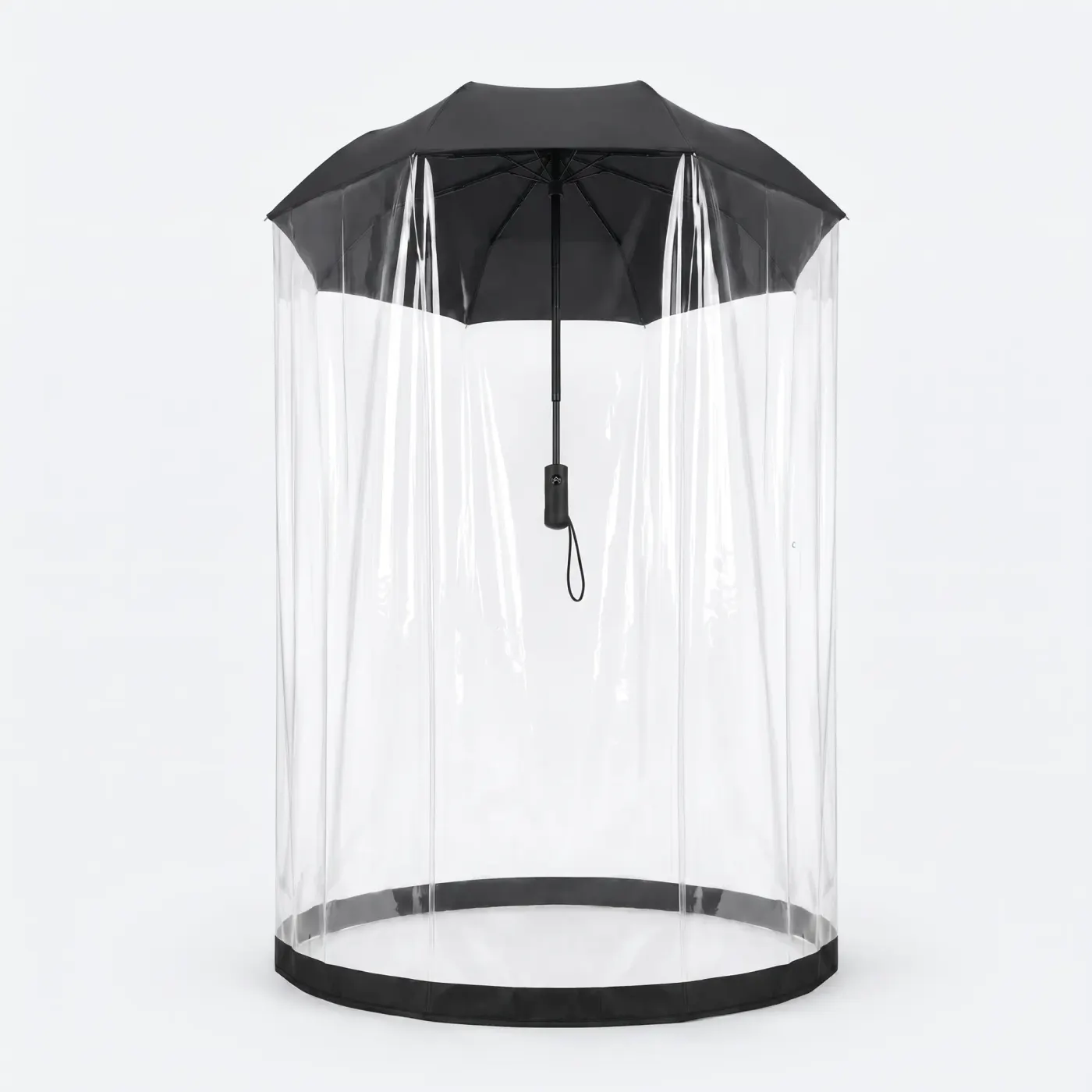
- A full body umbrella such as BrollyPod has a clear shield that hangs from the canopy almost to the ground, so the rain hits the shield instead of your legs. There is nothing to take off when you arrive. You just fold it away.
3. Keep your bag inside the cover
A bag hanging off one shoulder sits right in the path of sideways rain. Wear it on your front, tuck it under your coat, use a waterproof cover, or keep it inside the shield of a full body umbrella.
4. Choose the right shoes
Leather shoes treated with a waterproofing spray, or shoes with rubber soles and fewer seams, cope far better than canvas trainers. Keep a dry pair of socks in your bag on wet days.
5. Plan your route around splashes
Walk on the side of the pavement away from the kerb when you can. Spray from passing cars and puddles soaks the lower half of your legs, often more than the rain itself. A shield that hangs low catches most of it.
6. Stand behind something at the bus stop
Bus shelters are open on the side the rain usually comes from. Stand at the end that faces away from the wind, or use the shelter’s back panel as a windbreak.
7. Know when to close the umbrella
Any umbrella becomes hard work in strong gusts. If it’s pulling you about, angle it into the wind or close it and rely on your coat. No umbrella is made for storms.
What works best for a walking commute
If you walk to work or school and need to arrive looking presentable, the main problem is your trousers and shoes. A waterproof jacket handles your top half. For your legs, overtrousers are the most weatherproof choice, while a full body umbrella is the quickest: you open it, walk inside it and fold it away when you get there.
See our side by side comparison of full body umbrellas, bubble umbrellas, ponchos and overtrousers to choose what suits your journey.
Quick answers
What is the best umbrella for sideways rain?
An umbrella that gives you cover at the sides as well as on top. A full body umbrella does this with a clear shield that hangs almost to the ground. A bubble umbrella gives more side cover than a flat one, but only down to your shoulders.
How do I stop my trousers getting wet when it rains?
Cover the lower half of your body. Overtrousers, a long waterproof coat or a full body umbrella will all help. Avoid the edge of the pavement, where spray from cars and puddles reaches you.
Why does the bottom of my trousers always get wet?
Rain blows in under the umbrella at an angle, water runs off the canopy, and puddles splash upwards as you walk. All three land on the lower half of your legs.